Table of Contents
- What’s Actually Wrong? Identifying Your Door’s Failure Points
- The Real Numbers: What Repair and Replacement Actually Cost
- Why Modern Sliding Glass Doors Are Completely Different Technology
- 9 Critical Questions to Determine Repair or Replace
- What You Can’t Put a Price Tag On: Comfort, Safety, and Peace of Mind
- Key Takeaways
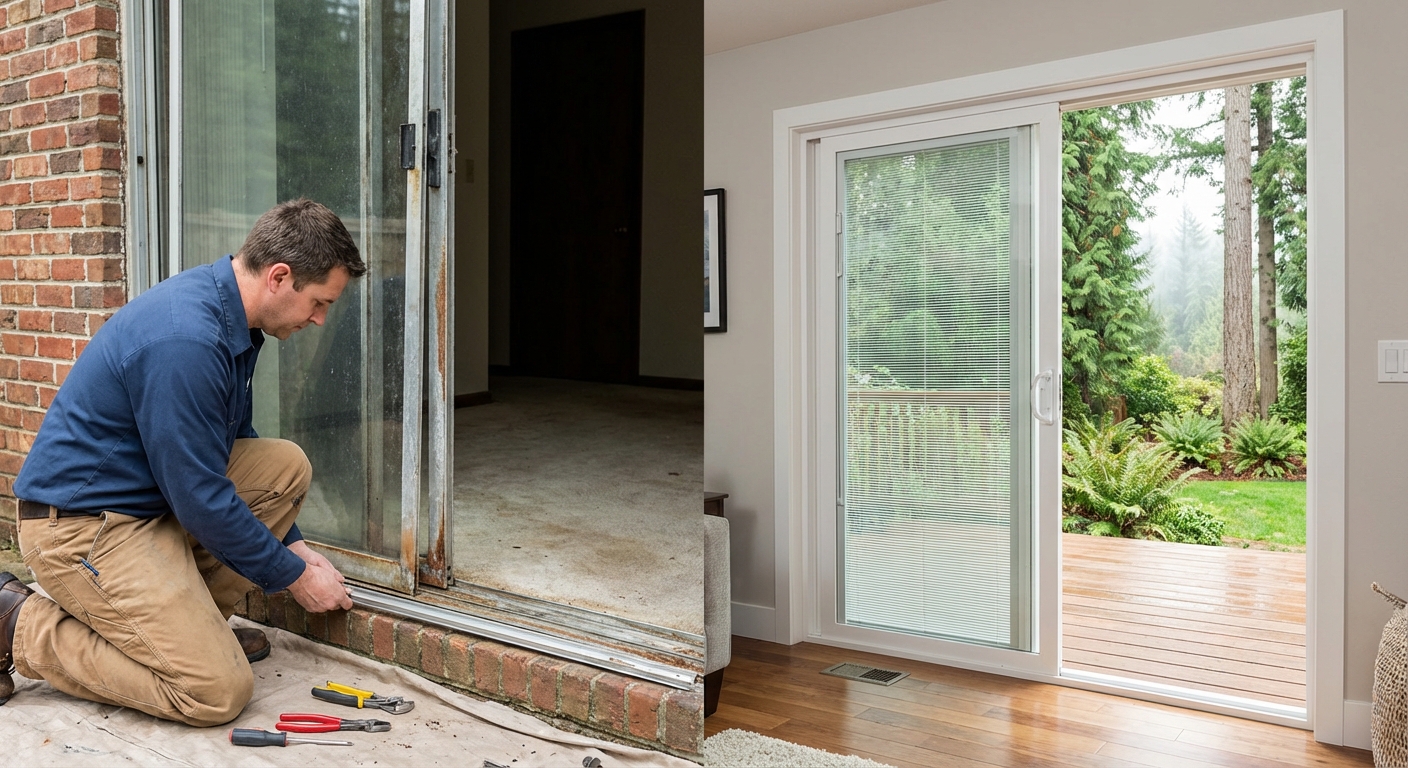
Is your sliding glass door sticking, leaking, or fogging up between the panes? You’re facing a decision thousands of Pacific Northwest homeowners grapple with every year: should you repair your existing door or invest in a full replacement? This isn’t always a straightforward choice. While a quick repair might seem like the budget-friendly option, it could be a Band-Aid on a bigger problem—leaving you with ongoing energy loss, security risks, and mounting costs. On the other hand, replacement represents a significant investment that requires careful consideration. The stakes are real: according to the U.S. Department of Energy, heat gain and loss through windows and doors account for 25-30% of residential heating and cooling energy use. In the Pacific Northwest’s climate, an inefficient door can cost you hundreds annually in wasted energy. This guide provides a clear, data-driven framework to help you make the right choice for your home and budget. We’ll walk through the most common failure points, compare repair and replacement costs specific to the Portland-Vancouver metro area, explain the significant technological advances in modern doors, and provide a decision checklist you can use today.
What’s Actually Wrong? Identifying Your Door’s Failure Points
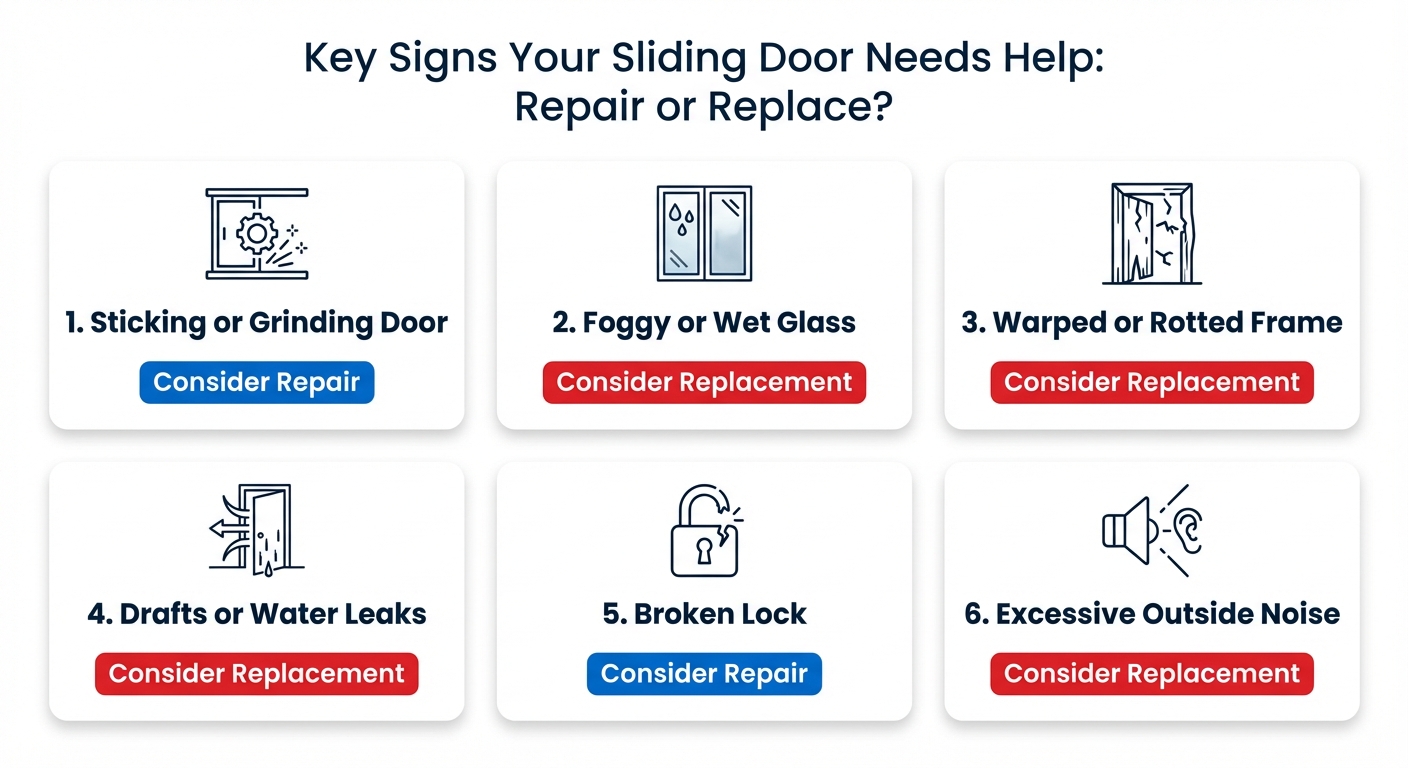
Before deciding on repair or replacement, you need to accurately diagnose the problem. Not all issues are created equal—some are simple fixes, while others signal systemic failure.
Mechanical Issues (Often Repairable)
Worn rollers: The most common problem. Rollers can corrode, break, or flatten from debris and repeated use, causing the door to stick, grind, or become difficult to move. Professional roller replacement from Town & Country Glass typically costs $150-$300 and can restore smooth operation on an otherwise sound door. Faulty locks and latches: Hardware failures from wear or misalignment. These are security risks but often straightforward to fix. Modern replacement hardware can even upgrade your security beyond the original components. Track damage: Bent, dented, or debris-clogged tracks. Minor damage can be repaired and cleaned; severe damage affecting door seating may require frame replacement.
Structural and Performance Failures (Usually Require Replacement)
Broken seal/foggy glass: The most critical non-repairable issue. If you see condensation, fogginess, or mineral deposits between glass panes, the insulated glass unit (IGU) seal has failed permanently. The inert gas has escaped and been replaced by moisture-laden air, destroying the door’s insulating properties. Frame damage: Warped, rotted (wood), or severely corroded (metal) frames compromise structural integrity, security, and weather resistance. The Window & Door Manufacturers Association confirms that compromised frames cannot provide proper sealing, leading to significant energy loss and potential water intrusion. Severe drafts and water leaks: If replacing weatherstripping doesn’t solve the problem, you’re likely dealing with frame warping or improper installation—issues that repair cannot address and may be causing hidden moisture damage to wall structures.
The Real Numbers: What Repair and Replacement Actually Cost in the Pacific Northwest
Understanding the complete financial picture—including installation, energy savings, and long-term value—is essential for making the right decision.
Typical Repair Costs (Portland/Vancouver Metro)
- Roller replacement: $150-$300
- Lock/hardware replacement: $100-$250
- Track repair/cleaning: $100-$200
- IGU glass panel replacement: $400-$1,000+ (depending on size and glass type)
- Multiple repairs: When you’re addressing 2-3 issues simultaneously, costs quickly approach $1,100-$1,500
Replacement Costs and Variables
- Standard vinyl sliding door (ENERGY STAR rated): $2,000-$3,500 installed
- Mid-range fiberglass door: $3,500-$5,000
- Premium wood-clad or high-performance door: $5,000-$7,000+
The 10-Year Financial Reality: A Portland Case Study
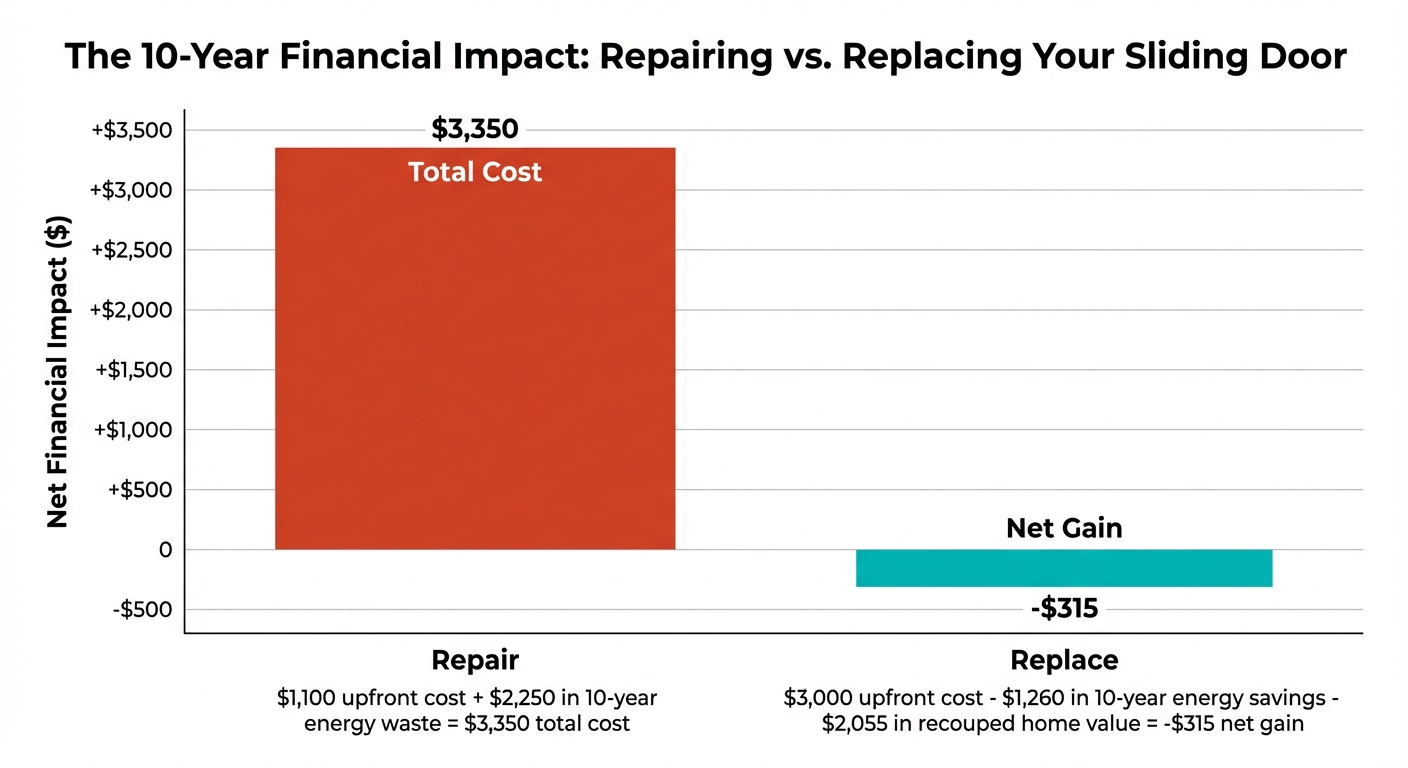
Scenario: 25-year-old aluminum builder-grade door with multiple issues
| Cost Factor | Repair Path | Replacement Path |
|---|---|---|
| Immediate Cost | ~$1,100 (rollers + IGU + lock) | $3,000 (ENERGY STAR vinyl door) |
| Energy Efficiency | Remains inefficient (U-factor ~0.80) | New door U-factor: ~0.28 |
| Annual Energy Impact | ~$200-$250 waste vs. modern door | $126 savings (per ENERGY STAR) |
| 10-Year Energy Cost | $2,000-$2,500 | $1,260 savings |
| Added Home Value | $0 | $2,055 (at 68.5% recoup) |
| Total 10-Year Cost | $3,100-$3,600 | -$315 (you’re ahead financially) |
The Hidden Costs of Repair
- Repairs don’t improve energy efficiency
- No warranty protection (new doors typically have 10-20 year warranties)
- No improvement to security, UV protection, or noise reduction
- Risk of additional failures requiring more repairs
Why Modern Sliding Glass Doors Aren’t Just “New”—They’re Completely Different Technology
The performance gap between a 20-year-old door and today’s technology is dramatic. Understanding these advances reveals why replacement often delivers value that repair simply cannot.
Revolutionary Glass Technology
Low-E Coatings: These microscopically thin, transparent metal coatings reflect thermal energy. They’re essential for meeting modern energy codes—keeping heat in during winter and blocking it in summer. A door without Low-E technology is functionally obsolete in the Pacific Northwest climate. Gas Fills: Modern IGUs are filled with Argon or Krypton gas. These inert gases are significantly denser than air, providing superior insulation and reducing heat transfer. Lawrence Berkeley National Laboratory confirms these fills can improve insulation performance by 20-30% compared to air-filled units.
Safety Glass Standards
- Tempered glass: 4-5 times stronger than standard glass; shatters into small, relatively harmless cubes if broken. Required by modern building codes for doors.
- Laminated glass: Features a polymer interlayer that holds glass together when shattered. Offers superior security, blocks up to 99% of UV rays, and dramatically improves sound reduction.
Energy Performance That Meets ENERGY STAR Standards
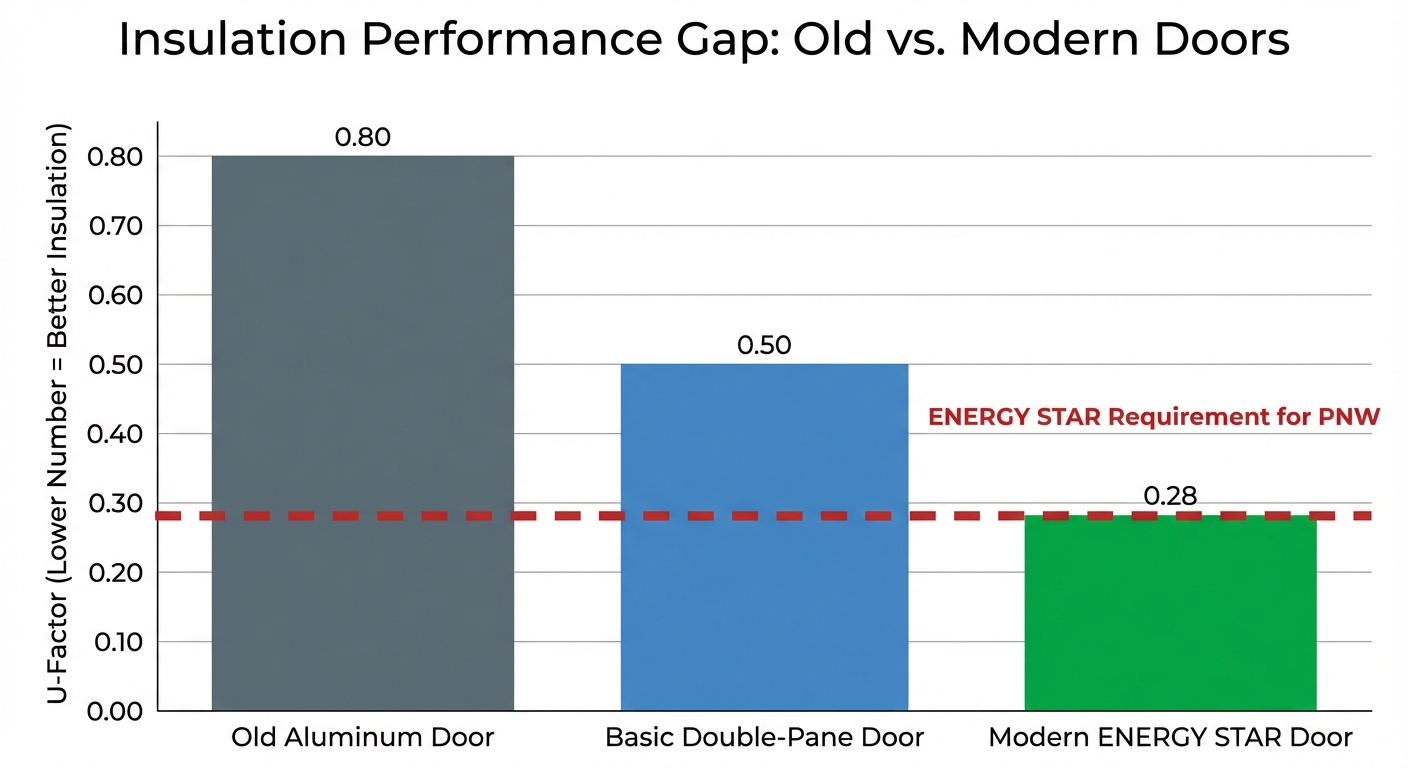
The National Fenestration Rating Council (NFRC) certifies door performance using two critical metrics: U-Factor (insulation): Measures heat transfer. Lower is better.
| Door Type | U-Factor |
|---|---|
| Old aluminum door | ~0.80 |
| Basic double-pane | ~0.50 |
| ENERGY STAR requirement (Pacific NW) | ≤0.28 |
| Modern triple-pane | ~0.15-0.20 |
Solar Heat Gain Coefficient (SHGC): Measures solar heat transmission. Lower is better.
- Old clear glass: 0.75-0.85
- ENERGY STAR requirement for Pacific Northwest: ≤0.40
- Modern Low-E glass: 0.25-0.35
Superior Frame Materials
- Vinyl: Multi-chambered construction provides excellent thermal insulation; low maintenance; most cost-effective.
- Fiberglass: Exceptional strength and durability; resistant to swelling, rotting, and warping—ideal for the Pacific Northwest’s damp climate. Premium insulation and longevity.
- Thermally-broken aluminum: Modern frames include structural thermal barriers that drastically reduce heat transfer compared to older solid aluminum frames.
9 Critical Questions to Determine If You Should Repair or Replace
Use this comprehensive checklist to evaluate your specific situation. Each factor is weighted based on industry research and real-world performance data.
Your Decision Framework
- < 10 years: Likely candidate for repair if issue is isolated
- 10-20 years: Evaluate energy performance and extent of damage
- > 20 years: Strong candidate for replacement due to obsolete technology and approaching end of functional life
- Single mechanical issue (rollers, lock): Usually repairable
- Foggy glass (seal failure): Replacement strongly recommended
- Multiple issues simultaneously: Cumulative repair costs approach replacement cost—poor ROI on old technology
- Minor cosmetic damage: Repair acceptable
- Warped, rotted, or corroded frame: Replacement mandatory—affects security, weather sealing, and structural integrity
- Minor drafts fixed by weatherstripping: Repair may suffice
- Persistent drafts or water intrusion: Indicates fundamental frame/seal issues; replacement necessary to prevent structural damage
- Meets ENERGY STAR standards (U-factor ≤0.28): Repair may be cost-effective
- Old, inefficient door (U-factor >0.40): Replacement saves money long-term through reduced energy bills
- Lock easily replaceable: Repair works
- Weak frame, non-safety glass, obsolete lock: Modern doors offer multi-point locking systems and code-compliant safety glazing
- Quiet neighborhood: Noise reduction not a priority
- Near traffic, airport, or commercial area: New doors with laminated glass achieve STC ratings of 35+, reducing perceived noise by 50% or more
- < 25% of replacement cost: Repair may be sensible if door is newer
- > 50% of replacement cost: Poor investment in old, inefficient technology
- Replacement adds immediate resale value (68.5% cost recoup in Pacific region) and appeals to buyers concerned with energy efficiency and modern features
What You Can’t Put a Price Tag On: Comfort, Safety, and Peace of Mind
While energy savings and resale value are quantifiable, modern sliding glass doors deliver quality-of-life improvements that repair simply cannot provide.
Acoustic Performance for Quieter Living
Noise pollution is an increasing concern, especially in urban areas of Portland and Vancouver. A 25-year-old door with standard double-pane glass may have a Sound Transmission Class (STC) rating of just 26-28. Modern doors with laminated glass options can achieve STC ratings of 35-40, resulting in a perceived noise reduction of 50% or more. For homeowners near Powell Boulevard, I-5, or PDX flight paths, this isn’t a luxury—it’s a necessity for quality of life.
Safety and Code Compliance
The International Residential Code (IRC) mandates safety glazing (tempered or laminated glass) in doors to prevent serious injury. Older doors may not meet current standards, creating liability concerns and potential issues during home inspections or sales. Modern safety glass:
- Tempered: Breaks into small, relatively harmless cubes rather than dangerous shards
- Laminated: Holds together when shattered, providing superior security against break-ins
- Both meet or exceed current building codes
UV Protection for Furnishings
UV radiation causes fading and deterioration of flooring, furniture, and artwork. Laminated glass blocks up to 99% of UV rays, protecting your interior investments for years to come—a benefit you’ll never get from repairing an old door with standard glass.
Enhanced Home Security
Modern sliding doors feature:
- Multi-point locking systems (vs. single-point locks on older doors)
- Reinforced frames designed to resist forced entry
- Laminated glass that’s extremely difficult to break through
- Optional security bars and sensors integrated into design
Improved Comfort and Consistent Temperatures
Drafty, inefficient doors create uncomfortable temperature variations and force your HVAC system to work harder. Modern doors with proper sealing and low U-factors maintain consistent interior temperatures, eliminating cold spots near the door and improving overall comfort.
Warranty Protection
Quality new doors come with comprehensive warranties (typically 10-20 years), providing peace of mind and protection against defects. Repairs on old doors carry no such protection. Town & Country Glass offers a 10-year guarantee on double pane windows, ensuring your investment is protected.
Key Takeaways
The repair-or-replace decision for your sliding glass door ultimately comes down to three factors: the age and condition of your existing door, the specific issues you’re experiencing, and your long-term plans for your home. If your door is less than 15 years old and the problem is isolated to a single mechanical component, a professional repair from an experienced glass company like Town & Country Glass is likely your most cost-effective solution. However, if your door is over 20 years old, showing multiple signs of failure, or suffering from seal failure or frame damage, the data is clear: replacement is the smarter long-term investment. You’ll recoup a significant portion of the cost in home value, save substantially on energy bills, and enjoy the comfort and security of modern technology. For Pacific Northwest homeowners, the typical 10-year net cost of replacement is actually lower than the combined costs of repairing an old, inefficient door—before even considering the quality-of-life improvements.
Ready to Make an Informed Decision?
Contact Town & Country Glass for a free, no-obligation assessment. Our experienced technicians will honestly evaluate your door and provide transparent recommendations for repair or replacement.
References:
- Family Handyman. (2023). How to Fix a Sliding Glass Door. Retrieved from https://www.familyhandyman.com/project/how-to-fix-a-sliding-glass-door/
- This Old House. (2022). How to Secure a Sliding Glass Door. Retrieved from https://www.thisoldhouse.com/doors/21018049/how-to-secure-a-sliding-glass-door
- U.S. Department of Energy, Office of Energy Efficiency & Renewable Energy. (n.d.). Update or Replace Windows. Retrieved from https://www.energy.gov/energysaver/update-or-replace-windows
- Window & Door Manufacturers Association (WDMA). (2021). WDMA Hallmark Certification Program Handbook. Retrieved from https://www.wdma.com/resources/hallmark-certification-program
- U.S. Department of Energy. (n.d.). Energy Performance Ratings for Windows, Doors, and Skylights. Retrieved from https://www.energy.gov/energysaver/energy-performance-ratings-windows-doors-and-skylights
- National Fenestration Rating Council (NFRC). (n.d.). The NFRC Label. Retrieved from https://nfrccommunity.org/page/TheNFRCLabel
- ENERGY STAR. (n.d.). ENERGY STAR Version 7.0 Residential Window, Door, and Skylight Final Specification. Retrieved from https://www.energystar.gov/products/spec/windows_doors_and_skylights_specification_version_7_0_pd
- Zonda Media. (2023). 2023 Cost vs. Value Report. Retrieved from https://www.remodeling.hw.net/cost-vs-value/2023/pacific/
- Glass Education Center by Vitro Architectural Glass. (n.d.). What is Low-E Glass? Retrieved from https://glassed.vitroglazings.com/topics/what-is-low-e-glass
- Lawrence Berkeley National Laboratory. (n.d.). Gas-Filled Windows. Retrieved from https://windows.lbl.gov/technologies/gas-filled-windows
- National Glass Association (NGA). (n.d.). A Guide to Safety Glazing. Retrieved from https://www.glass.org/resource-topic/safety-glazing
- ENERGY STAR. (n.d.). Savings for Windows. Retrieved from https://www.energystar.gov/products/windows_doors_skylights/savings
- Forbes Home. (2024). Sliding Glass Door Repair: A Complete Guide. Retrieved from https://www.forbes.com/home-improvement/windows/sliding-glass-door-repair/
- HomeGuide. (2024). How Much Does It Cost to Replace a Sliding Glass Door? Retrieved from https://homeguide.com/costs/sliding-glass-door-replacement-cost
- International Code Council. (2021). 2021 International Residential Code – R308.4 Hazardous Locations. Retrieved from https://codes.iccsafe.org/content/IRC2021P2/chapter-3-building-planning#IRC2021P2_Pt03_Ch03_SecR308.4
- Soundproof Windows, Inc. (n.d.). STC Ratings. Retrieved from https://www.soundproofwindows.com/stc-ratings/